

TLDR: Jumia trades at ~$6 and I own the January 2028 $7/$15 call spread for $1.15, which pays around 7:1 if this company finally stops burning cash.
The last time the stock traded in the mid-teens was in January.
Sara’s Soapbox (skip if you don’t want my unsolicited advice)
So, let’s start with some disclaimers.
I own a variety of call spreads like this one, so take this as a case study as opposed to a YOLO. This ain’t the stock for that.
I have had a number of these setups work out like QURE, which was my single largest call spread for the year.
Another one I have going on that is on the larger end is TTWO, which I entered into a while ago when the stock was approaching $200 earlier in the year.
Same with Reddit and about a dozen others, which I am not going to write about because I am not your financial advisor or interested in telling you how to buy and sell your stocks.
The key is to have enough of these going on so that the heroes outweigh the zeros.
Since so many of you ask in DM’s, large for me is 250 to 500 bps.
I manage binary special situation risk by baker’s dozen investing and use of options/arbitrage.
I try to make enough smart decisions on average to outperform the market on a rolling multi-year basis.
You are not trying to beat the Black-Scholes quants on math.
Trust me, we both aren’t smart enough for that.
(Well maybe you are. I barely passed DFQ.)
What you have that they don’t is the ability to research into individual stock names, where you know a thesis better than a computer model, which is focused on making money on the macro and not on the micro.
OK, enough pontificating. This isn’t a learn how to trade blog.
Join me on the road to educated degeneracy below.
The trade
I bought January 2028 $7 calls for $2.30 and sold the January 2028 $15 calls against them for $1.15, so a net cost of $1.15 per share.
That gives me seventeen months and $8.00 of potential delta between the strikes, or $6.85 of potential profit, which is a 6X potential return or a 7:1 ratio.
Breakeven at expiry is $8.15, so you need the stock up ~35% just to get your money back, and you need $15 for the full value.
That’s the maths (I like how the British say it and this is my international blog).
Why am I betting on this shitco with over $2.2 billion of losses to date?
Supposedly, they are going to achieve break even in Q4 2026 on an adjusted EBITDA and cash‑flow basis and deliver full‑year adjusted EBITDA profitability in 2027.
Is it possible?
Well that’s the bet and so far this company has rolled 00 to date.
What they burned to get here
Jumia, which was previously tied to Rocket Internet, was trying to build Amazon across Africa, in fourteen countries simultaneously, while also running food delivery, classifieds, travel booking and groceries.
It listed in April 2019, peaked at $65 in February 2021 for reasons that had nothing whatsoever to do with African e-commerce, and has been skiing downhill since.
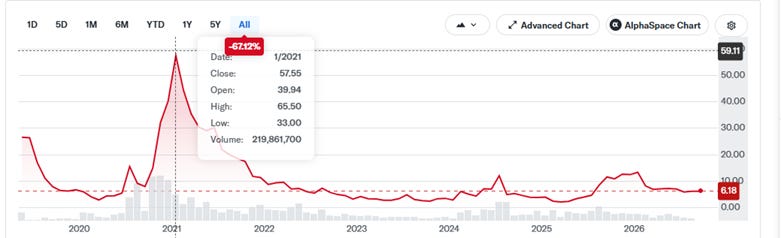
The bears were right about this stock for six straight years and they had every reason to be. It was a financial disaster on the order of Pets.com
Francis Dufay took over at the end of 2022 and spent three years trying to right the ship.
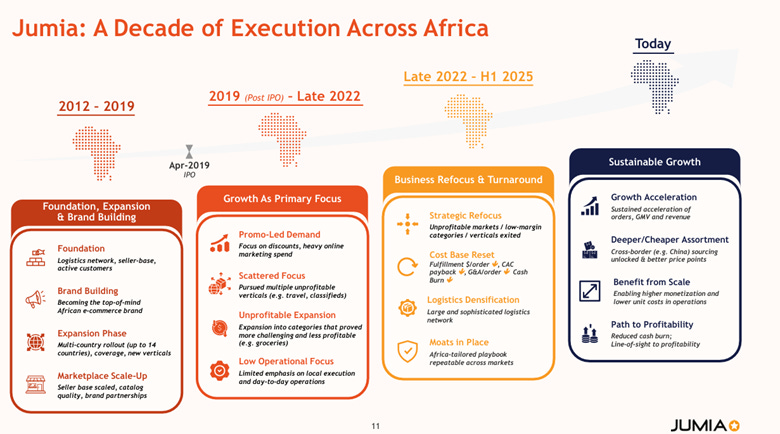
The various verticals it had were wrapped up, countries were cut down, and the cash burn came down from $285 million to $107 million in 2023, $81 million in 2024 and $56 million in 2025. An admirable effort on his part.
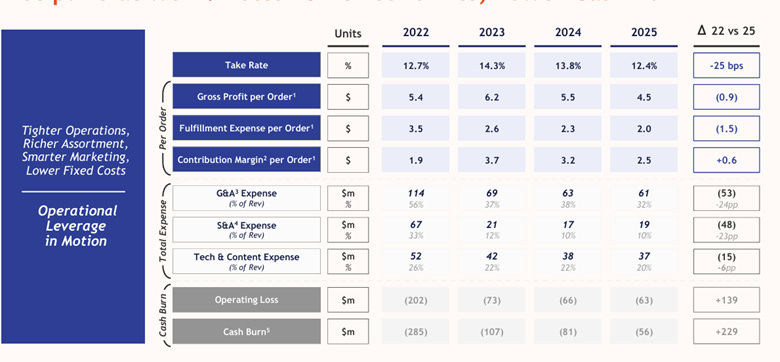
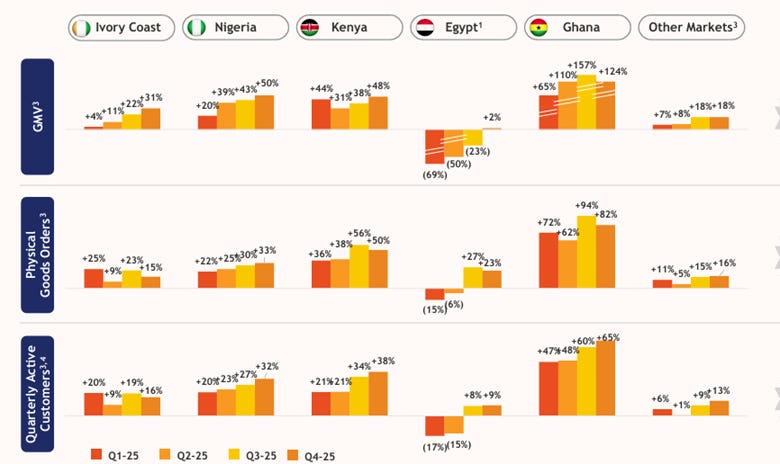
Headcount is now just over 1,770, which is down from ~4,300 back a few years ago. Other metrics are show above if you are curious.
They also switched their model selling less of their own crap and selling more of others, becoming more a market place and fulfillment company, while also creating centralized pick-up points for goods decreasing last mile transportation costs with a focus on a few key African markets.
Yeah, I know that was a mouthful, but due to this model they somehow managed to lose less money in 2Q even though the entire world was in an uproar.
The last quarter
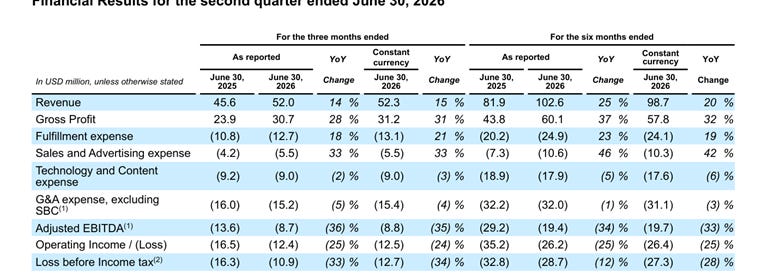
GMV was $216.3 million, up 23% adjusting for the Algeria exit, and gross profit was $30.7 million, up 28%.
Orders came in at 6.3 million and quarterly active customers at 2.6 million, both up better than 20%, and the Adjusted EBITDA loss was $8.7 million against $13.6 million a year ago.
Nigeria GMV was up 36%, Ghana up 77%, Egypt up 45%, and Ivory Coast, which is 21% of physical goods GMV, was down 1% because cocoa prices have been in flux.
So when do the losses actually stop?
Q1 2025 was a $15.7 million loss, Q2 2025 was $13.6 million, Q1 2026 was $10.7 million (which was $9.7 million excluding Algeria exit costs) and Q2 2026 was $8.7 million.
Management says Q4 2026 is when they stop losing money on an adjusted EBITDA and cash‑flow basis.
“We cannot say with certainty how long these headwinds will last, but Q2 proved that we have the right fundamentals to navigate this kind of macro uncertainty without losing our path to profitability on an adjusted EBITDA basis. We are confident that our path to Q4 break even is intact.“
CEO Dufay 2Q Call
If we map this out on a plot (which I am too lazy to do), I can’t really support his statements, but if you look at the trend it has been coming down even in the face of chip costs (which affect mobile phone and electronic sales, especially for poorer countries) and Iran oil prices, which increase transportation expenses.
I am thinking they hit break even in Q3 2027. If they manage to do it earlier than that, all the better, but I structured my calls to allow them until Q4 2027 to get their shit together.
When a company that has lost money historically starts making money, the stock price reprices aggressively.
Just look at Lensar (a major TripleS holding) which reported last week.
The raise
On August 11 they priced 9.1 million ADSs at $5.52 for $50 million gross, anchored by $25 million from the International Finance Corporation with Axian coming along for the ride.
The International Finance Corporation (IFC) is the largest global development institution focused exclusively on the private sector in developing countries.
It’s nice that a World Bank member is willing to invest in this business, which you can take any way you want. I thought it was a positive development.
IFC money is patient in a way hedge fund or retail money isn’t.
This also gives them enough funds to reach their break even point, assuming they meet their promises.
The CEO denied they needed the money. I disagree, but who cares what I think?
“To your second question about the raise, why now and what’s the point? I’ve said 1,000x in the past, we don’t need cash to make it to breakeven, and that hasn’t changed. What hasn’t changed as well is that the plan is not changing, clearly. The absolute focus is profitability in Q4 and full-year 2027 cash and adjusted EBITDA breakeven as well.
Why we’re doing this raise now, I think the big trigger is clearly the opportunity to onboard the IFC, the International Finance Corporation. The IFC is one of the most reliable and the best names you can get on your cap table when you operate like us as a listed company in Africa. They bring with them credibility in the eyes of other institutions.
They run very deep due diligence on the ground with the teams, and it shows that our model can support that kind of scrutiny. They invest as a partner. Their mandate is to develop private sector in Africa. They invest as a partner. We’re going to drive impact together on a number of topics. It’s also going to help us get better access, better understanding from local regulators and public institutions.”
CEO Dufay 2Q Call
Why the short call at $15
The 52 week high on this is $14.72, back in January, so I have sold a call above anything the stock has managed in two years.
Is $15 unreasonable?
Post raise there are roughly 133 million ADSs out, so fifteen dollars is a $2.0 billion market cap for the only scaled listed e-commerce platform on the continent of Africa.
Comparing this to MercadoLibre and others, I think this is doable if they do what they say they are going to do.
You can choose a different strike if it makes you happier.
Risks

Middle East fuel prices, Cocoa upsets. Global memory prices. Multiple currencies and economies. A history of losses. Unstable governments. All the risks.
In the same vein, these challenges give Jumia a MOAT.
Conclusion
So, in summary, there are two ways this ends.
They print a breakeven-ish Q4, deliver a much better 2027 with the losses going toward zero, and the market stops pricing this as a serial money loser and starts pricing it as a functioning e-commerce business, in which case the stock easily goes above $15 and our $1.15 turns into $8.00.
Or this company continues to disappoint and fails on all metrics. There is a reason you are getting a huge multiple on this option trade. Be prepared for a zero.
Either way we had fun, right?
If you enjoyed this write-up, please like and restack.
I don’t get paid to do this, so consider that my reward.
Substack seems to throttle free article writers, which makes attracting new readers difficult. I do not want to charge for this substack, but the algorithm may end up requiring it. I am trying to avoid this, so please spread this substack if you can.
Also, if you have other ideas I should write about, my DM’s are always open on substack and Bluesky :)
All writeups are subject to our TOS
Living in Abidjan, Ivory Coast, I'm like a super user of Jumia. Have ordered tons of charging cables, kids toys, a microwave, headphones, razors, a robot vacuum cleaner, and even a whole refrigerator. They don't have as broad range of goods as Amazon, but still quite a lot, and it works. And beats the alternative which is driving through the notoriously difficult Abidjan traffic to a shop where things will be more expensive, if available at all.
If Jumia went bust - which looked quite possible at times - it would definitely make life less convenient.
Unlike food delivery (Glovo) or the Uber equivalent (Yango), Jumia's drivers dont follow an online map. They call you and you have to describe the path to your place which can be difficult as addresses dont really exist. I just use a nearby government ministry building, and walk there to meet the Jumia delivery guy who typically has a motorbike with a box. They used to come with vans, but I guess motorbikes are cheaper. And I guess mobile data is expensive so they just use voice (can't say they aren't serious about hitting breakeven). I have tried to tell the jumia delivery guys to just give me their whatsapp number (everybody uses whatsapp in the Ivory Coast) and I'll send my exact location, but they always say no.
Never really thought of Jumia as an investment case, seemed like a terrible business - I just hoped from a customer perspective that they would stay around. But short and long term trends are favourable to Jumia I think - the population as well as the purchasing power/middle class is increasing in their markets, and the younger more internet savvy generation will increasingly see it as an indispensable convenience. And who wants to burn money for years to compete with jumia?
Thanks for this write-up. One question on your trade structure. I know the options you used have a lot of runway, but why use options at all giving the uncertainty on timing?
Is it because you view this as a binary zero or hero situation anyway so you might as well get more juice?