
Seer
The Board Said No to Everybody, Including Its Own CEO

UPDATE
SEER Board of Directors won so likely going to be a not great outcome unless they accept the new offer by Bradley Rackoff. Sorry this does not seem to be working out!
https://www.stocktitan.net/news/SEER/seer-stockholders-vote-to-re-elect-all-seven-of-seer-s-director-8bin18wpayp4.html
This is going to be a mostly Claude written article as I am extremely busy today, but I think this needs to get out immediately and this is too long for a note.
Also not a large position for me, but it is about to have a huge inflection point (up or down).
Forgive any errors as I am literally writing this over lunch and feel free to correct me in the comments.
TLDR: Seer trades around $2.04 against roughly $3.90 a share of cash and investments and no debt. Five separate buyout proposals have hit this board since April. It rejected every single one, including the one from its own Chairman and CEO. All three proxy advisors told shareholders to vote for change. The annual meeting is today at 1:30 Pacific and there was just a new offer put out this afternoon.
Alright, onto the article.
What it is
Seer sells the Proteograph. Nanoparticle-based sample prep that lets a lab pull proteins out of a blood sample with more depth than the standard workflow.
Revenue has been flat at roughly $16 million for four straight years. 2026 guidance is $16 to $18 million. They shipped a third-generation product last year and the line didn’t move.
Q1 2026 revenue was $2.8 million, down 34% year over year.
Against that, they spend $40 million-plus on R&D and $40 million-plus on SG&A, every year.
Seer went public in December 2020 at $19.00. It trades at $2.04. That’s a 97% haircut, and about $311 million of cash burned getting there.
Farokhzad’s own strategic plan, the one presented to his own board, does not reach profitability until 2031.
So they need eleven years from IPO to make a dollar. Cool.
The numbers that matter
Share price: $2.04
Shares outstanding: ~56.4 million (fully diluted closer to 64 million)
Market cap: ~$115 million
Cash, equivalents and investments at March 31: $219.5 million
Debt: none
Net cash per share: ~$3.90 on the basic count, call it $3.40 fully diluted
$115 million (market cap) − $219.5 million (cash) = negative $105 million enterprise value.
Q1 burn was about $16 million, up from $12 million the year before. Call it $60 million a year, or roughly $0.28 per share out the door every quarter.
March 31 was four months ago.
Discounts on melting ice cubes are not free money. They are a bet on somebody stopping the melt.
Why this became possible at all
For most of its public life this company could not be touched.
Farokhzad held super-voting Class B shares carrying ten votes each, which gave him about 40% of the voting power. Any shareholder opposition was theater.
The Class B had a mandatory sunset. Management tried to extend it five more years, filed a preliminary proxy in October 2025 asking shareholders to approve exactly that, and dropped the plan only after being told it would violate Nasdaq’s listing standards.
Read that sentence again. They went for another five years of founder control and stopped because the exchange made them.
The shares converted one-for-one in December 2025. Farokhzad now owns about 8%. Management collectively about 13%.
The board has also been declassified since 2023, so all seven directors stand for election today.
Two months after the conversion, on February 20, Radoff and Torok filed a 13D.
The offers
February 26. Seer reports a weak FY2025, guides FY2026 to nothing, and announces the NOL poison pill on the same day. Stock closes 17% lower the next day.
April 13. Bradley Radoff and Michael Torok, roughly 7.6% of the stock, put in a non-binding proposal at $2.25 a share in cash, a 33% premium at the time, plus a CVR paying holders 80% of net proceeds from any license, sale or disposition of Seer’s business and assets, including its PrognomiQ stake. Conditioned on at least $215 million of net cash at closing. No financing condition. They offered to post a non-performance fee so the board would know they’d close. Same day, they nominated three directors.
Rejected.
April 24. Second proposal. $2.35, a 39% premium to the unaffected $1.69 close of April 10, same CVR. They add a substantial reverse break fee and offer to inject $10 million into the company.
Rejected. Per the activists, the board never picked up the phone.
May 14. Third proposal. $2.40, a 42% premium, same CVR.
Rejected. All three. Per the Radoff group, the board did not engage on any of them.
June 15. They offered to fold the proxy fight entirely in exchange for governance changes and a tender offer for 20 million shares at $2.50 — that’s 36% of the shares out. The board, which had asked for suggestions, didn’t answer.
July 1. Omid Farokhzad, Chairman and CEO, writes to his own board in his personal capacity as a stockholder. He proposes to take Seer private at $2.45 per share in cash, plus two contingent value rights: a tiered revenue-linked CVR worth up to $0.25, and a tiered sale-linked CVR worth up to $2.91.
July 2. The board forms a Special Committee. Two days. For three months of activist letters, they formed nothing.
July 20. The Special Committee unanimously rejects the CEO’s proposal. It “undervalues Seer and fails to reflect the value of Seer’s long-term growth prospects.”
So this board has now told four separate bidders no, and one of them was the guy who runs the company.
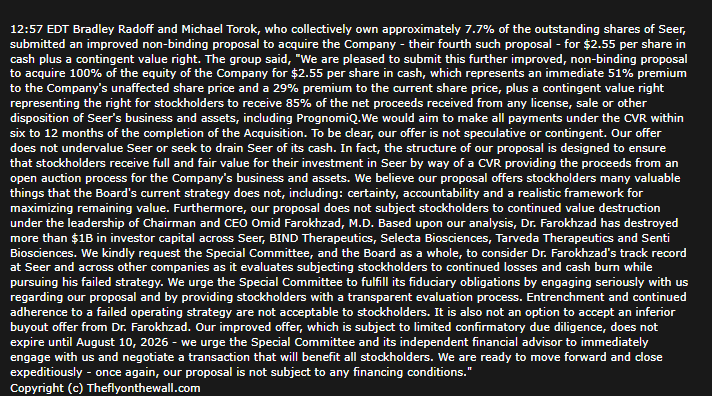
Today is the latest and greatest offer
Haircutting the CVRs
The CEO’s headline package adds to $2.45 + $0.25 + $2.91 = $5.61. Canaccord kept a Buy and a $4 target and called the CVR structure logical.
Call the package $2.45 plus a lottery ticket. Which is about 63% of net cash.
Now put Radoff’s CVR next to it: 85% of net proceeds, uncapped, on any disposition including PrognomiQ, with the sale run as an open auction.
The new offer from today is $2.55 + 1 CVR as the highest water mark.
The NOLs, since the board keeps invoking them
The stated reason for the poison pill is protecting $262.4 million of federal and $226.6 million of state net operating losses, which expire in 2035.
The governance situation
This is the ugly part, and it’s why we’re voting today.
The Tax Benefit Preservation Plan triggers at 4.9% beneficial ownership and runs through February 25, 2029. Ratification is on today’s ballot.
A 4.9% trigger is very low. That is not a tax plan with an anti-takeover side effect. That’s an anti-takeover plan with a tax rationale stapled on.
Then in March, the company amended the pill to settle a shareholder lawsuit, tightening the beneficial ownership definition to actual economic ownership and stripping out the loose acting-in-concert language. They paid $250,000 to make it go away.
You do not settle a suit over your own poison pill’s drafting if the drafting was legal.
The activists argue five of seven directors aren’t truly independent, including Isaac Ro, whose employer is a significant PrognomiQ investor and who sits on PrognomiQ’s board.
And the proxy advisors came in.
All three of them recommended FOR the Radoff-JEC nominees, WITHHOLD on Terrance McGuire and Dipchand Nishar, and AGAINST the pill.
ISS went further, adding a WITHHOLD on Roelofs, one of the two people on the Special Committee that just rejected a buyout, and wrote that Seer has lost over 95% of its market cap since IPO with little evidence a turnaround is imminent.
Glass Lewis cited prolonged underperformance, continued operating losses and an uncertain path to commercial scale.
Can they actually win?
Here’s the register.
Radoff-JEC: 7.7%
SoftBank: 9.1%
aMoon Fund: 8.7%
Invus Public Equities: 7.4%
That’s 33% if the three VCs go along. Management holds about 13%.
At the 2025 meeting, roughly 11% of votes were withheld from a single director. That number understates everything, because Farokhzad still had 40% of the vote in his pocket and there were no competing nominees. Opposing him was pointless, so nobody bothered.
This is the first vote at this company that actually counts.
On Radoff, both sides of it
The wins are real. At VHC he got a $1.00 special dividend on a $1.40 stock plus 80% of future Apple litigation proceeds. At LFVN, a $0.40 special dividend three months in. At SESN he and another activist forced the merger consideration’s cash component from $0.12 to $0.34. GHSI sold its main asset and liquidated, and it worked.
The misses are also real, and they’re recent.
Tetra Technologies, March 2025: nominated four, launched an aggressive fight, then withdrew the whole slate a month later with no explanation.
Atea Pharmaceuticals: pushed for a sale or liquidation, ended up settling for one board seat and a $25 million buyback.
Alto Ingredients: two directors stepped down, Radoff signed a standstill and got his expenses reimbursed.
The other side of the argument
Every activist bid has come in below the cash on the balance sheet. The company’s own proxy put it plainly: roughly $141 million of offer against roughly $220 million of cash. On that specific fact the board is correct. $2.40 is not $3.90.
The problem is what comes next.
If you reject every bid because it’s below cash, the burden is on you to do something better with the cash. Instead the plan is to spend $60 million a year until 2031 on a product line that has done $16 million a year for four years running.
I't’s a race to 0.
The risks: At $0.28 a share a quarter, net cash walks down toward the bid price on its own.
This can go to zero-ish
A CEO-led buyout with a two-person special committee is a Delaware problem waiting to happen.
The pill caps the fix. No strategic buyer builds a position past 4.9% without eating dilution. If it’s ratified today, the most likely buyer stays the guy already inside.
Conclusion
Two outcomes, and today decides which.
A) The activists take one or two seats, the pill ratification fails, and the board loses the authority to keep saying no. A real strategic review starts and a deal gets done.
B) The board sweeps it. Then you own a company burning $60 million a year, behind a 4.9% wall, run by a man whose plan reaches profitability in 2031 and whose last two companies were a Chapter 11 sold to Pfizer for a sixth of its IPO valuation and a reverse merger. In that case $2.04 wasn’t cheap. It was correctly priced for a board that would rather burn the cash than hand it back, and this trades under $1.50 by Christmas.
If you enjoyed this write-up, please like and restack.
I don’t get paid to do this, so consider that my reward.
Substack seems to throttle free article writers, which makes attracting new readers difficult. I do not want to charge for this substack, but the algorithm may end up requiring it. I am trying to avoid this, so please spread this substack if you can.
Also, if you have other ideas I should write about, my DMs are always open on Substack and Bluesky :)
All writeups are subject to our TOS
The swen ones are more interesting risk reward wise but this is just happening right now this second
The level of shareholder apathy is amazing in situations like this. I’m not sure whether Radoff helps or hurts. On one hand you can be assured SOMETHING will happen. The question with him is whether that SOMETHING will be for his sole benefit or if it will benefit all shareholders.
This one seems like it was worth the roll of the dice though.